Systems & Research
Spatial Venue
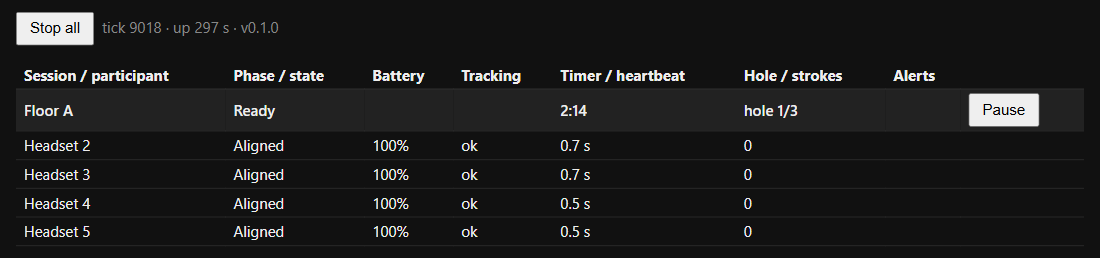
A Rust server that runs shared sessions for several headsets in the same room, with a live status page, a command-line control tool, and a DASP control socket for automation.
Multiplayer game development
Networked gameplay goes wrong in the details: a dropped player who cannot rejoin, an inventory that disagrees between machines, a level that generates differently on each machine, a floor nobody can run.
For game teams and venues that need several players, or several headsets in one room, to share one correct session.
Worked example
Spatial Venue is our server for location-based XR. It owns the roster, phases, scores, course, props, and settings of a session, validates what each headset reports, and streams bit-packed snapshots to every headset 30 times a second over UDP, with reconnect tokens so a dropped headset rejoins in place.
Around the server sit the tools a floor needs: a client library shipped as a Unity package, a read-only status page with a live feed, a command-line control tool with a JSON mode for people and for agents, and a DASP control socket so automation can drive a session without patching the game. Load tests run 48 simulated players across 8 sessions, and the decoders are fuzzed.
runs server-authoritative sessions with reconnects, a status page, and a control tool.
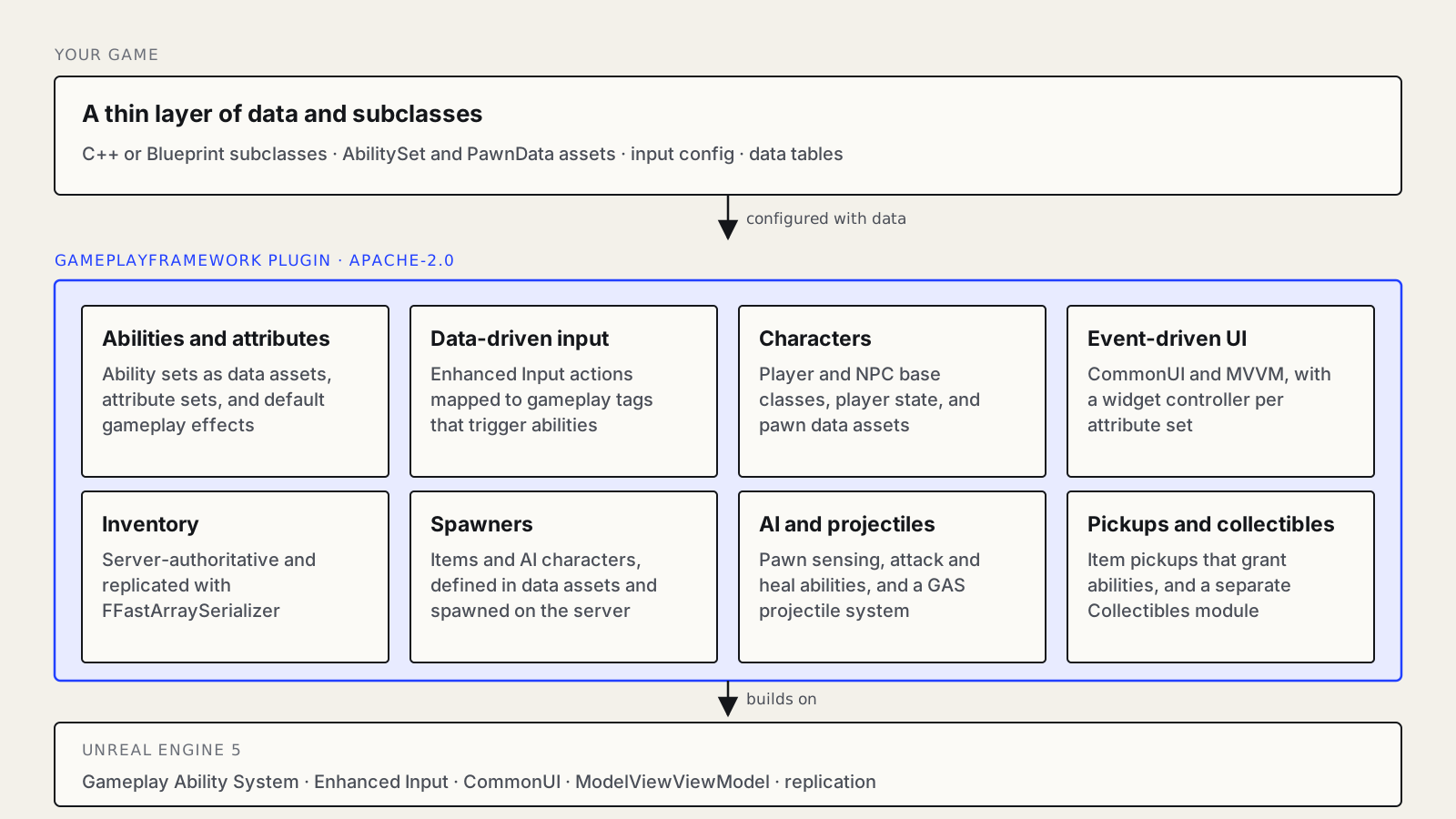
gives an Unreal game replicated abilities, attributes, inventory, and seeded procedural levels that every client generates identically.
lets automation drive a session through a control socket instead of patching the game client.
is the Unity starting point for the headset side on Meta Quest 3 and Android XR.
is the Unreal plugin for games and installations that take part in DASP experiences.
Deterministic, server-authoritative state streamed to every client, with reconnects that put a dropped player back in place.
Abilities, attributes, inventory, and spawning that stay correct over the network, configured with data rather than code.
Native client libraries shipped as Unity and Unreal packages, with one codebase per engine across devices.
Seeded levels and layouts that every client generates identically.
Status pages, control tools, and JSON interfaces so people and agents can run sessions.
Simulated players that fill sessions, and fuzzed decoders on every network boundary.
Projects
Systems & Research
A Rust server that runs shared sessions for several headsets in the same room, with a live status page, a command-line control tool, and a DASP control socket for automation.

Experiences & Worlds
Mixed-reality mini-golf on Meta Quest 3 and Android XR from one codebase, with holes generated from the scanned room and a venue client that connects the game to our Spatial Venue server.
Systems & Research
An open-source Unreal Engine plugin for building replicated, data-driven games on the Gameplay Ability System. GlitchWalker and Collectors Edition are built on it.
Where to start
We run one game mode server-authoritative with two to four players, or load-test the server you already have with simulated players.
Next step
Plan a multiplayer systemGet in touch
Describe it in a few sentences. You get a draft brief to review before anything is sent.